Radio WORM: Give Chance a Chance
Radio WORM – Phew! A lot of activity and development, bundled into a relatively short time: the station began on a table in the downstairs office, then moved to its current location, the colourful studio that looks out on Wunderbar’s foyer.
Now it has 150 regular shows, 1000s of broadcasts in the archive, around 200 people currently making radio for WORM. Radio WORM has grown a wide network, and yet it all comes from this 36 sqm space with a couple of mics, a mixer and a pair of old CDJs. All these people, ideas, imagination squeezed into, and broadcasting out of, such a small space.
Lots of things have changed since 2020, but one constant since 2021 has been Ash Kilmartin. We asked her to take her headphones off and answer some questions about the station and her part in its growth, on the eve of a new year’s programming and the 25 Hour Radio Relay this January.
How does all this – Radio WORM, radio, even – fit into your wider practice as an artist?
Organising has always been part of my own practice. As an undergrad at art school in New Zealand, I could see that the most interesting exhibitions – the events with the most energy and meaning – were held in the spaces that artists organised for themselves. Why wait for someone to invite you, when you and your pals can invite each other and do things exactly as you want to?
Small-scale, self-made radio has shaped the direction of my work since 2016, when a classmate and I at the Piet Zwart Institute decided to set up a temporary radio station for our Master of Fine Art open studios day. We didn’t want to show work-in-progress, we wanted to share the spirit of the programme and all the incredible, unseen things that were going on in that building. Conversations and experiments, failures and jokes. The proper stuff of artistic practice! From that point on, I’ve ventured further into working with sound, enjoying how it can capture the essence of a time and place without relying on our visual sense; or how it can lean into the ephemeral, being totally unrepeatable. You just have to be there for it. It also relates to my interest in print and books, it’s a way to share ideas in a very portable, inexpensive way.
What is it about radio and making radio? What is the power of listening for you?
Listening is pleasure, and pleasure is power. Sound moves people. In the cultural field, we might often feel a pressure to be attending to all the ill that goes on in the world around us, to take it all seriously, to be good citizens. But playing, and listening for pleasure – to dance, to learn, to chill, to reset, to wake up, to be surprised – that can also give us the energy we need to deal with the ill.
And part of radio’s magic as a medium is its capaciousness. You can fit almost anything into this thing. Whatever your niche interest, there’s a way to put it on the radio, and people do. Because of its inherent capacity for variety, listening to radio becomes an exercise in chance, like browsing books at a charity shop or going to a small museum: you might have come for the gqom hour, but now you’re suddenly listening to a radio play about rare birds. You hear a song you know and enjoy, or something you’ve never heard before? You’ve just expanded your contact with the sensuous world.
The act of listening can be creative, it can be critical and generous. It can also be passive, lazy, impatient, unthinking, reactionary. There’s no one single way to listen. But cultivating different modes of listening gives us tools to be more patient, to be genuinely curious, and more attentive to the spaces we inhabit. Really listening gives us something in common, across differences. It doesn’t universalise, it’s a way to simply be together.
With Radio WORM, we encourage people to ‘listen weirder’: to challenge themselves to listen differently, to not reach immediately for the known ‘on-demand’ or to know exactly what they want to hear, but to give chance a chance.
When is radio not radio?
What’s the difference between a radio show and a podcast? Having material on demand isn’t good for us, is it? (Ahem…)
To be honest: when I hear ‘podcast’ I cringe. Sorry, podcasts! But is there really a difference between podcasts and web radio?
One major distinction is that when you’re making live radio, anything can happen and can’t be edited out or smoothed over. The most engaging radio happens when things don’t go to plan, when you just don’t know how it will unravel. You have to embrace the risk, enjoy interacting in real time. Life is constant improvisation, right?
Best of all, those people who are listening to you are all joined up in this invisible, intangible community of listeners. They are paying attention, they are attending to the same thing, tending it through tuning in – saying hi in the chat, DMing to say they’re listening, asking for track IDs. Participating. Those listeners make the show with you. There is a bizarre unity of strangers out there, linked only by the fact that they, too, are listening right now. Sharing space-time.
This is how broadcast media used to be all the time, with no option to listen back later. I guess I take that for granted. Before streaming media became the norm, I might be listening to the radio, knowing friends elsewhere were listening to the same show. You’d listen for two hours just in case your new favourite song would be played, and be elated for three and a half minutes when it was. Monday morning at school, everyone was talking about the TV show that everyone watched the night before. I relish this sense of a disembodied common public space through media. And I see internet radio listeners from different cities, different countries, meeting up in real life at music festivals – like old school CB radio pirates trading ID cards, or peer-to-peer filesharers and internet forum users meeting at gigs. It gives us different ways to come together with people who share one specific interest.
I do seriously believe the accessibility of podcasting as a medium is of immense value to an independent and grass-roots media, despite the clichés of vacuousness that the term might evoke. The availability of web radio shows through listen-back platforms is incredibly important. Podcasting will forever play a role as the sibling and ‘memory’ of internet radio as a form, as well as providing an on-demand archive, for artists and audiences alike. It’s an endless communal portfolio of our lives as makers and listeners. It’s hard to imagine radio without that, now.
Radio WORM, its triumphs and travails
And at WORM? How do you see this as part of the wider WORM ecology?
Radio is the newest ‘department’ at WORM, but I would argue: is the WORMest. It was the WORMies – bar staff, technicians, programmers, volunteers – who formed the core of Radio WORM when the COVID lockdowns hit. It was basically the only live programming that could go ahead in that period. It’s simply grown from that little hothouse moment, to be open to more makers and a wider audience.
It reflects WORM as a space where people make things, not just take things in. It also shows WORM is a place of access: to tools that people can actively use, and a place where you can build a community. You don’t need to know how to make radio: you just need a good idea, and the time and energy to make that idea happen.
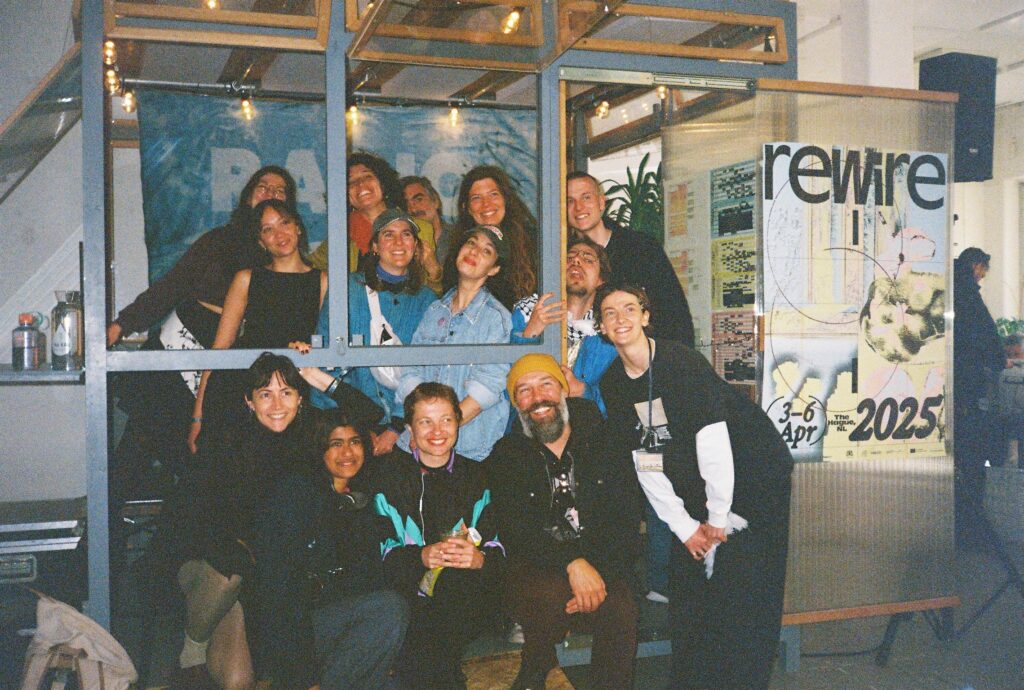
I really like how it works in both directions, too: the rest of WORM comes to the Radio, and Radio can take WORM out into the world – at festivals, doing residencies, and other live events. Since 2023 we’ve been the broadcast partner for Rewire Festival’s context programme, streaming live from the festival; and we have a great long-term exchange of artists and ideas with legendary Glasgow collective Radiophrenia. We also send our radiomakers out to festivals all over the place to interview artists and bring back their personal reports of the scenes they’re interested in. It’s a way to make WORM travel, and bring the world back to us.
Of course, not everything has gone smoothly over the years…
We’ve learnt a lot along the way, after endless technical breakdowns and occasional social bust-ups. There was never an instruction manual for “How to Radio Station” or “How to Community”. An exasperated host once complained, “this is not Hilversum!” I couldn’t agree more, gladly.
We had a great series of live broadcast-concerts called Expanded Radio. Everyone wanted to play these Sunday afternoon events, we were constantly being asked to do them, but actually hardly any audience showed up. The performances were really good, but we couldn’t go on scheduling them for an empty room, it was too disheartening.
For years, our system for broadcasting and recording shows kept messing up. Every radiomaker would produce their own show, and most wouldn’t correctly save their files. The gear would be constantly, mysteriously, out of order. And I spent a lot of time finding and training studio volunteers, but they had so little to do. In the end we just had to upgrade the computer and streaming infrastructure. A small investment that made an enormous difference to how much we can offer the radiomakers.
We rely heavily on the generosity and energy of our makers, and I try to anticipate what will make it more fun, more meaningful for them to be involved.
But one success was 2024’s 25 Hour Radio Relay. Tell us, why is WORM doing it again?
The most worthwhile moments are when we can all get together, like our Matchmaking B2B sessions in the Wunderbar, where DJs are set up to play back to back without knowing in advance who they’ll play with. This is when I really feel the sense of community. Or workshops, like our XLR series for young radiomakers; and radio intern Marco’s blindfolded sampling/jingle-making session. Most of all the 25 Hour Radio Relay, which is radiomakers, WORMies and a bunch of performers from elsewhere, too.