Feature: Riccardo Calandro – Archiving at WORM
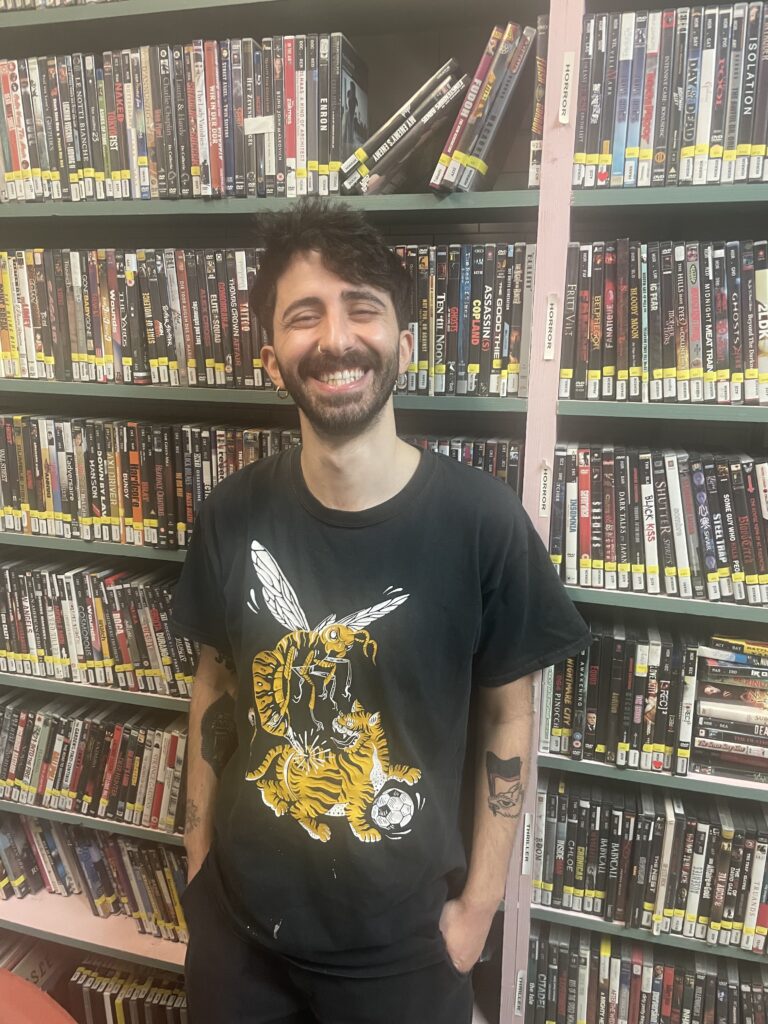
Riccardo Calandro is a familiar face in WORM, who has worked in our bar team and, alongside Ari Ralph, was for a number of years part of the inhouse archivist team at WORM Pirate Bay. Riccardo has recently busied himself with initiating activities that stem from his time archiving WORM’s wild and wonderful alternative resources. These are: WORM’s Underground Kino Club, a night that enables underground and DIY filmmakers and video artists to share their work and build an alternative film community; and Archival Revival: a night built on the premise of “movies for everyone, with everyone”; bringing back cinema to its collective and connective nature, whilst enjoying the new, or unexpected, with new friends and likeminds. We asked Riccardo for his thoughts behind his recent work.
How did you develop these nights, is it a big switch from your time archiving the Pirate Bay, to this more events-based approach?
RC: It’s a bit more nuanced. I was the latest arrival in the Pirate Bay environment – and I am the one who is still hanging around! My approach, which is what I learned from James [Parnell] and Ari [Ralph], is to have a dialectical relationship with the communities that shaped the archive. Of course, it’s WORM’s archive, but it has developed in the way it has because of the collectives, practitioners and artists who worked with it. And so, to achieve this kind of approach, if it wants to be functional, it constantly needs a relationship with its environment.
…Right now there is never enough time to create and take care of the archive as I would like to but the idea is to still be active. I am convinced that any archive has potential.
Actually, I should have asked you, what is an archive? Because that helps us understand what goes on at WORM, maybe. It seems to me that it’s a shifting set of items and memories and people, that is reused in different ways…
It’s a question that every archivist out there can answer in a thousand different ways. I think here it’s basically a space in which you can save and develop a cultural heritage. How can I describe it? Maybe it’s the “luggage” of a specific place, a neighbourhood; or its past; or where it is going to. It’s also a tool that redefines itself through other identities.
You use the word revival in one of your night’s names. What is it at WORM that needs reviving?
First of all, the archive is not really accessible to people at the moment, so this is a way to make it so. Specifically, the film and video archive. But in a way that it is not just contemplative; for a lot of people the word archive means a bunch of things shown, and put away again. But if you approach the WORM archive in the right way it can really be an active place. So: the goal is to show that the archive is still alive, and to show the guests that the archive is something they can bring to life, with their own approach. There are endless possibilities. And you don’t need a lot of money – it’s based around different objects.
…In the long run, the goal is to make it as collectively accessible as possible. More people means more, and differing, points of view reshaping the archive.
How do you feel that idea moves around the groups you work with? Can you give an example?
I can see there is a sentimental attachment to the archive for WORM’s communities, for sure. And any time there is an event even in a remotely linked archive, there is a strong response. It’s not clear what will happen in the future – but if the archive sticks to its values, we are okay. The values are, I would say, “accessibility” which is better expressed as “open sourceness”: this means no paywalls and a chance for people to make programmes with it. We need to keep the dialectical relationship with the audience going – right now I am hinting towards that, with the work I am doing.
So there is a plasticity to the archive? In that it can be reemployed. There is obviously a lot of care that you have in presenting material, too.
Politically speaking we are rediscovering the importance of the physical object, or media and its ownership, that can enhance its worth. Now, given that everything [in the wider world] is consumer-orientated, and in a time where we can’t do anything with an object if we don’t consume it, a place like WORM’s archive is something we can use in different ways. There is a lot of potential, societally.
Is it part of, or another step towards, the wider politicisation of the body? The archive is an echo of the old idea of you being a walking library of things you’ve accumulated in your head, is that right?
Yeah. And the whole point of culture, whether it’s political or not, is to exchange things. Culture is alive because it’s always acting as an exchange. I wouldn’t think this [work in the archive] is bringing anything back. And it’s also strange to think about twenty years ago; this idea of physical versus digital wasn’t such a battle.
How do you place the objects to visitors?
With Archival Revival, I try to highlight the values behind the film archive, which Ari named as an archive based on independent movies, camp movies, or horror or B-movies. Of course, the things that you pick bring forth specific cultural values. They show where you stand a little bit, including giving space to an independent production. Each approach has a value. This approach links directly to the Underground Kino Club, which always looks to give space to underground artists. We want to show people there is an alternative way to the mainstream.
OK, we have talked a bit about exchange and underground practices. Where do you see the membrane between the outside world and the archive? And do you want to break through to the outside world?
I definitely want to break through, one hundred percent. A phrase is engraved in my mind, I can’t remember who said it but the phrase is “the purpose of art is to highlight needs that cannot be satisfied.” And [when we look to the world currently] this is just the beginning of a complete lack of agency and ownership that is happening “out there”. As a space in the cultural avant-garde we should be aware of how things are going. It’s not up to us to solve any issues but we should report and highlight what is happening and what the alternatives are.
Do you think archives are sensory?
I really like this idea. I would say there is a common idea of an archive that creates a kind of reverence. Initially I saw huge archives as really scary, but then I learned that you can shape how the archive can make you feel. It can be a profoundly welcoming place, it can be a playground in the end. So it’s up to the creators! People seem to think you cannot touch the past but with an archive we can reshape the past, constantly, and we should do it.