It Can Happen Anywhere – WORM interviews RESIDUE
WORM is a place where an enormous amount of activity happens outside the public-facing programme. Over recent years, WORM has given “space out of sight” to climate activists, barbers, community choirs, diverse maker groups, organisations working with young, special interest, or needs groups, as well as homeless charities, cultural workers, and representatives of the many diasporas that see Rotterdam as home: such as the Mano Eritrea band. Often the activities are centred around topics that may seem secondary or with no fixed, end goal. These activities nevertheless represent crucial work in developing certain ideas and interests, or just giving time to think where a particular socio-cultural or artistic practice “is”, in the world. No clear end goal can also be seen as a strength, of course; and the process is just like leaving a field fallow after a harvest. One such project is RESIDUE.
Introduction to Residue
The project started in March 2025 as a monthly meeting group of performance and visual artists, art historians and art theorists. Over time it became known as the RESIDUE Performance Art Workgroup. They set out to see whether there was an interest in collaborative research, into how artists deal with documentation within performance art.
At first the meet-ups took place in each others’ studios but eventually RESIDUE ended up in the Precious space in WORM. Over time, new guests were invited to explain their practice within the framework of documentation and a wider group has formed. The core group is: Larysa Bauge, Nina Boas, Jolanda Jansen, Kirsten Heshusius, Barbara Krulik and ieke Trinks.
We caught up with ieke Trinks and Nina Boas to tell us what was happening. And ieke was very keen to point out at the beginning of our talk that theatre and performance are really different things, as are performance and performance art…
ieke Trinks: “There’s a lot of confusion and ideas around what these terms mean or embody, also in our group!”
Do your discussions ever end at RESIDUE?
NB – We still feel we don’t feel we dive in it enough. We started with a very informal meet up, but we wanted to invite people from outside our group as well, so we needed a place that is a bit more neutral so we began meeting in Precious.
…We felt that just having meetings and conversations about archives and looking at each others’ work is really something that is (taking me, personally,) hard to give time to. Because I am always busy with the producing and making of a work. And I want to have time to see where I stand, and with others, in a group. That organism is so inspirational, because I realised that documentation can be done in many different ways. It isn’t just using a video, or a text.
iT – Having this group is great because – as colleagues – artists don’t really have much time to discuss work. You just experience things: by going to shows, and things like that. But actually the process of exchange is often very minimal. Also, live art is in a moment – and then you have all these documentation materials. And there’s the (resulting) question: what do we do with it? In fact, should we do something with it – is it necessary, even? If you have a fixed object you can exhibit a number of times, but is it still interesting to look back at live events? And in what way?
NB – It’s a question of, how do you contextualise all these objects, and that “echo” around a piece, that ephemeral moment that just happens. And actually, that moment can be one continuing in memory, in a body, and also in how other people have heard about it. It’s a bit about noticing that whole “bubble” that can form and move around a work.
The trials of “living in the now” is often seen in a place like WORM – an endless fight between preserving the past and continually looking forward. We are surrounded by memories and echoes at WORM – we can’t escape them. Perpetually being in the middle of a history, because it’s obviously continual.
NB – It’s really interesting: especially since (with this group’s work) I entered this “rollercoaster”, going back and forth in time! I personally went into the archives of other performance artists and began talking about body memory and what I captured from those pieces, and how they integrated in my own performance – this movement but then also using that to create a new piece… So this timeline movement is quite interesting.
iT – I think the past is always “in there”, and noticing that is interesting, especially currently.
NB – Going back to theatre: I see the difference with theatre and performance, is that with theatre we are practising, and we have a text and we rehearse these things. I think with performance you are standing on the shoulders of all these experiences that you have had in these live moments, which can not be seen as rehearsals, because there are always audiences. And in that sense it’s a very different way of building up a piece. But it is “standing on” that archive, an (archival) world, that we also move through with our bodies. It is a different way of creating.
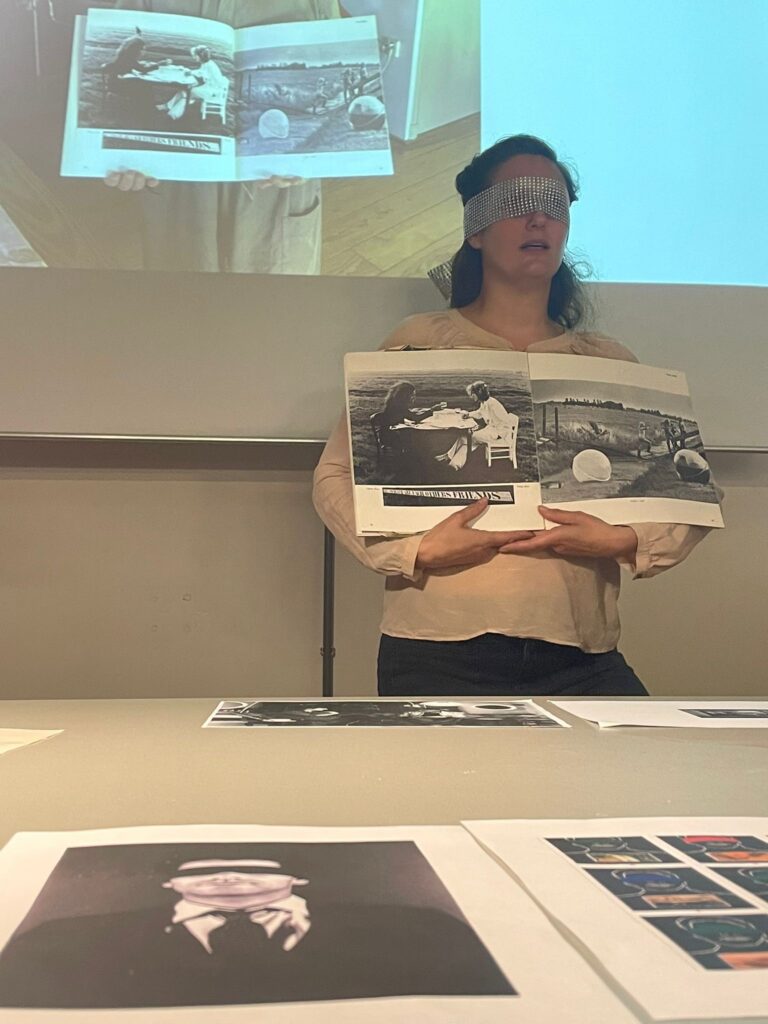
(Image: Nina Boas presenting her ongoing research project The Improvised Family. In her hands is the book Lucht, Water, Vuur, Aarde (Air, Water, Fire, Earth) by Fons Elders, shown enlarged in the projection behind her. The book features artists Flavio Pons and Philip Boas (her father) and was published in 1977. In the foreground is an image of Claudio Goulart. RESIDUE gathering Precious, WORM, 16 June 2026)
So what is it about WORM, in Rotterdam that drew you here?
NB – I grew up in Amsterdam, but lived here for ten years and performed here, in 2008 in the Wolphaertstraat for example: it’s a long history! And I feel that Rotterdam has such an easy way to enter places and find your space. And I am talking with many Amsterdam institutions, and there are possibilities there, but it’s such a slow process, and you’re dealing with many other archives, basically! Here it’s super easy. You can also become invisible almost, because it’s so easy.
…Two years ago we wanted to go deeper in connecting with each other, because you can create and facilitate events for others but we should ask: what is it precisely that we are getting out of that process? The encounters are the most important thing: people staying over and having breakfast, the build up, that sort of thing. We wanted to facilitate that so RESIDUE became the new group.
Do you want to have a stop point in all this documentation? And how would you finish it?
iT – We are more and more living in a society where things need to be explained. And that’s like a hapklare koek! [Laughs.] But I think the things that are very interesting are not easy to digest. They require some work and different kinds of work.
NB – It is an organic process, we are not looking to work out what we want to do, or thinking what a “result” should be; it’s more a case of what is interesting to everyone personally, those who decide to participate, and find something in it.
iT – Everyone has a focus on why they are doing something. And for me I did work a lot in my own process on what documentation means – but I never really saw what my colleagues thought, despite working with them and noting who also worked “in this way”. So I wanted RESIDUE to exist so that there will be more exchange, and it becomes a practice or an artform in itself.
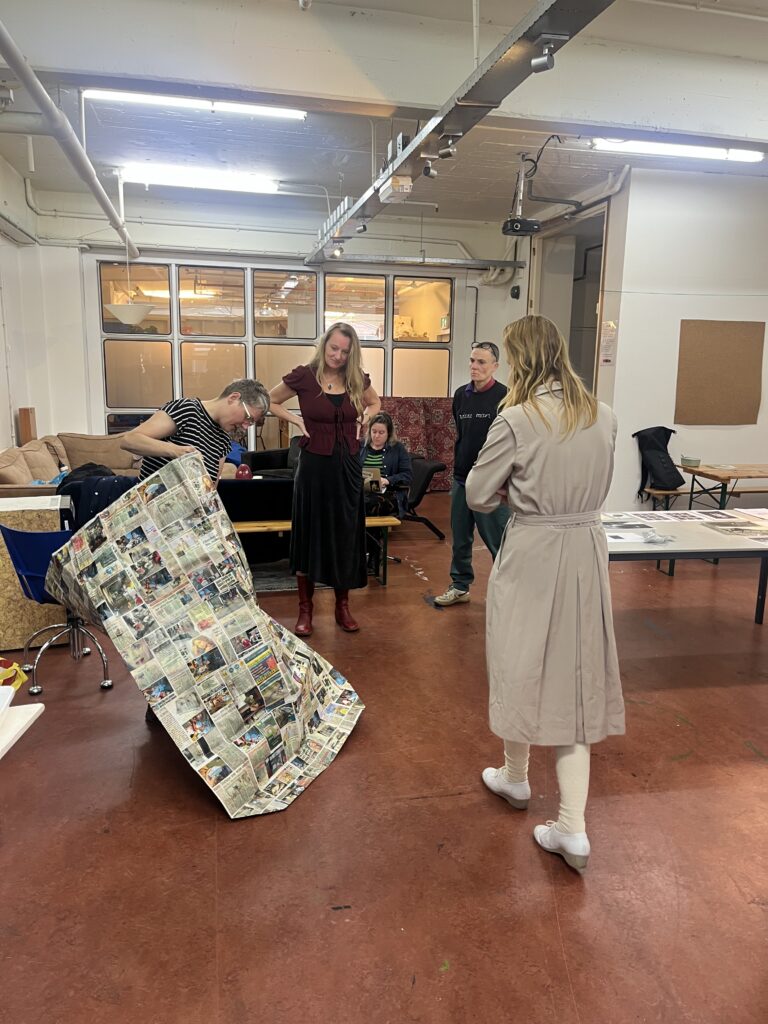
(Image: ieke Trinks presenting a Thonga, a Bengali word for a paper bag inspired on Indian newspaper bags, in the picture you see a human size paper bag including images of Trinks her performances with the bag. RESIDUE gathering Precious, WORM, 16 June 2026.)
People forget stuff!
iT – It can also be a situation where you don’t want to document something! There is this idea – because performance art is very much in the moment – that documentation creates something false or creates a false idea of what that would have been. There are many different opinions around that, too.
It’s an interesting time to document – this period where the rise of AI will radically reform the way things are documented because of the way AI takes and presents information.
iT – When we talk with guests, Toine Horvers, for example: he started in the eighties, when the digital world wasn’t yet fully developed. At first he sent a physical newsletter, and this got overtaken by email. At some point as an artist, you have to make a decision with new technology.
NB – So, at de Appel Archive, Nel Donkers, she was collecting Toine’s newsletters. But now that physicality has gone. Things have changed a lot, especially with the beginning of digital culture.
…I’m working with the Oudekerk because they want to do stuff with their publicised archive – and I saw they were missing a really crucial piece I remember seeing as a fourteen year old. And I said, ‘You don’t have this in your archive’. That is one of the reasons I went into archival work because I know the performance, I saw it. But where did it go? And now I am busy setting up meetings where the Oudekerk is talking to this organisation in Brazil, so that they can connect, because they each have something. Because it wasn’t digitalised, it means it doesn’t exist.
iT – This is also a mistake that any archive would also be complete…
What is completion? And in this case what are you working towards with RESIDUE?
iT – Practically, we are working towards an exhibition. And that will be one of the things we will try to do, and we will do that here, in WORM.
NB – I feel it’s a much more fluid process where we are trying to understand each other through constantly acknowledging each other, being present for each other – all these things create and hold space for each other, to actually “go into” the practice of looking back. I have a hard time doing it on my own. Society, or the arts scene, or “something” in this world is not making me have time for this.
iT – I think there is not necessarily a clear goal to where it is going. I think if the interest around the project is dying, then it dies. But of course, I personally think, as an artist, we all want to create new things. So we do want to make an exhibition and a screening and a performance event or whatever: maybe a hybrid form of things.
…And we are not the first to do this, there are other projects around live art and performance art and the question of archives and representation and re-production. Different times give different responses, and what does it mean in these times.
NB – Institutions have decided this art piece is important because we have it in our archive and we touch it with white gloves… and the same artist will have another piece that never gets this valuation…
iT – Some artists will never even get to there. And things become holy, which is a bit crazy…
NB – Exactly! And why shouldn’t we set up our own archive? There is a big play around this: so much stuff is being kept in Amersfoort in that huge archive of the Netherlands, it’s crazy!
And I knew a bloke who ran a squat in Leiden and he had all the flyers from all his gigs, a few thousand, under his bed!
NB – Domesticity is important, because it’s part of the archiving process: and it’s so funny because it’s also the same with performance art: it can happen everywhere! In your bedroom!
…But we were very careful in the beginning on how to publicise this and what we were going to do, because we wanted to create a safe space. But the informality of it means you go deeper into questions around the work. We did all kinds of embodiment exercises, for example.
iT – Even if it’s a repetition of something we had already done.
NB – We’re not original!
iT – Repetition is what humans do! Repetition is part of us: even if we just talk about gestures, we pass on gestures to one another. You express yourself physically, by doing a certain action and people read it and recognise it, and you are familiar with these interactions – shaking hands or giving a hug, for example. And we are able to read these things, even if there are some cultural differences.
NB – And we are talking to artists who do their work in the most unnoticeable places.
iT – Or making documentation that doesn’t fit.
…And that’s the magic, seeing what is left behind, what is the residue.

Image: Discussing performance costumes and clothes, in the image, Marieke Coppens showing her self-made costume for her performance The O stands for: reenactment chalk rite (2020) RESIDUE gathering Precious, WORM, 10 February 2026.)
All image credits are: RESIDUE collective.