Introducing: Social Reproductive Feminism
From February to May 2026, WORM hosts and co-curates a monthly film series, presented by Soctalk, exploring cinema through the lens of social reproduction feminism. The first screening night is named The Constant Work, taking place on Wednesday February 25th. The programme consists of three films. Other nights are Reproductive Justice on Wednesday the 25th of March, The Household on the 29th April and Maintenance is a Drag on the 20th May.
Soctalk is a junior staff initiative within the Department of Public Administration and Sociology at Erasmus University Rotterdam. We asked Charlotte Waltz, a postdoctoral researcher at Erasmus University Rotterdam and co-producer of the project with Guusje Enneking, to introduce the ideas behind series.
What does the term social reproduction describe, in your opinon?
Social reproduction is a term for something we all know intimately, even if we don’t know how to name it. It is the work that makes life possible: caring for others, cleaning, cooking, comforting, maintaining relationships, tending to bodies, homes, and institutions. It is the labour that happens before and after something what we usually call ‘work’.
Much of this labour is unpaid, undervalued, or simply expected. Often from marginalised people and communities. Because it is taken for granted, it is easy to overlook just how central it is to keep society running. As geographer Cindi Katz puts it, social reproduction is the fleshy, messy, and indeterminate stuff of everyday life. What this film series tries to do is make that stuff visible, as a main event.
This idea of social reproduction not being so visible: Do you think that it is just overlooked, or thought of an unimportant?
Social reproduction isn’t hidden in the sense that we encounter it every day. What is hidden is its value. This work is usually framed as natural, private, or a matter of personal responsibility, rather than as something social, political, and economic. Capitalist systems rely on this labour as a free and limitless ‘good’. If care, maintenance, and emotional labour were fully recognised and supported, the system would have to be very different. It is not social reproduction that is hidden per se, rather it is so essential to our being that the whole system depends on us not paying attention to it too closely.
Each night has a different theme, correct? Are these nights introductions to specific instances?
The films in this programme do not just document social reproduction, they disturb how we usually think about it. They show care and maintenance as sites of both exploitation and resistance, places where power is imposed but also challenged, and reimagined. Across our themed screenings, the programme travels through homes, hospitals, museums, and bedrooms to explore how these acts can both uphold the system and push back against it. Along the way, it shows how the personal is never just personal, it’s political, too.
The series asks how life is sustained, by whom, and at what cost. What happens when people refuse to keep running things as expected? Each screening focuses on a different pressure point, or a moment where social reproduction becomes visible, contested, or breaks down.
For instance, the first screening, The Constant Work, focuses on how social reproductive labour can be reappropriated as art. Jobs such as cleaning or repairing are often invisible, yet fundamental to public life. By foregrounding maintenance as a creative and political practice, this programme challenges dominant ideas of value and artistic production.
Who are the key makers in this movement? Who should we look out for?
What’s exciting is that many of these works arrive at similar concerns from very different places: documentary, experimental film, personal narrative, institutional critique. The series invites audiences to notice these connections and begin to see social reproduction as a shared terrain across art, politics, etc.
Additionally, the medium of film is a great fit for this theme, not only by what the films depict, but also because of how they are made. Jodie Mack’s stop-motion film, Yard Work is Hard Work serves as a quintessential example. Since repetition can be understood as a key characteristic of social reproductive work, the film’s frame-by-frame construction and the constant work of reshuffling images mirror this process, turning the act of filmmaking itself into a form of social reproduction.
Tell us about the Rotterdam aspects of this programme.
This programme is a collaboration between WORM and SocTalk, a collective of junior researchers based at Erasmus University Rotterdam. SocTalk works at the intersection of academia and the city, experimenting with ways to build cultures of care within and beyond institutional settings. For us, this collaboration is about redistributing resources, sharing care outside the university, and supporting amazing spaces and initiatives in Rotterdam, such as WORM. The film series is one way of doing that: an attempt to practice social reproduction.
Additionally, for decades, the image of Rotterdam, as a harbour city, has been shaped by labour. The city is often summed up by the saying “niet lullen, maar poetsen” (literally: no talking, but cleaning). Yet the poetsen this city came to stand for was never really about care, cleaning, or tending to bodies, homes and each other. It pointed instead to hard, manual work in the harbour: visible, relentless, and paid. This programme turns its gaze elsewhere.
It draws attention to other types of labour that more quietly hold the city together—the unpaid, often unseen care work, maintenance, and emotional support that keeps Rotterdam’s workers, their lives, and the city itself afloat.
Introducing the SocTalk team
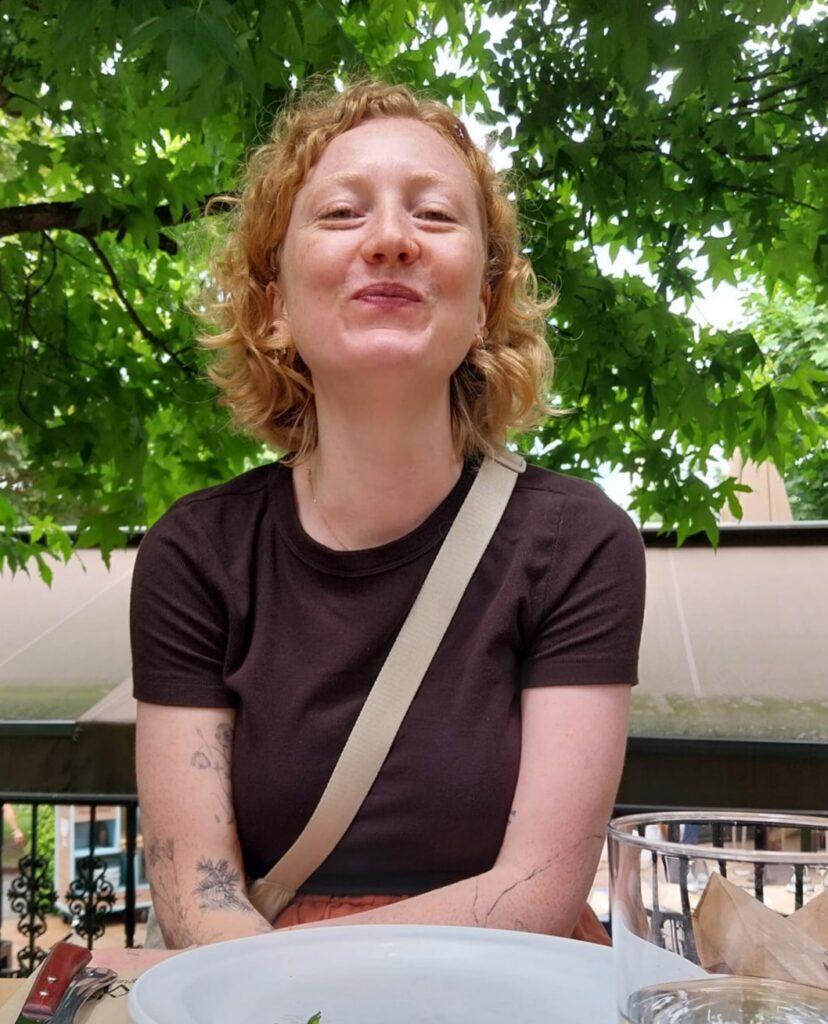
Guusje Enneking
I am a PhD researcher at Erasmus University Rotterdam and member of SocTalk. Drawing on scholarship in human geography, sociology, and feminist theory, my research explores the (re)production and maintenance of urban social infrastructure for care and welfare practices. By adopting a biographical approach, I aim to illustrate how individuals maintain, institutionalize, and defend these social infrastructures from below, as well as the power dynamics involved in this. I also hold a degree in architecture, which continues to inform my (personal and) research interests and curiosity for the city of Rotterdam.

Charlotte Waltz
I am a postdoctoral researcher at Erasmus University Rotterdam and member of SocTalk. My research brings together perspectives from anthropology, sociology, and feminist theory to investigate how state institutions respond to political change, crisis, and competing knowledge claims, and how governance practices can address structural inequities. From reproductive justice to pandemic preparedness, my work develops creative methodologies to examine how care, knowledge, and policy are co-produced in moments of transformation and crisis. I am also a board member for S.A.F.E. – Supporting Abortions For Everyone.